
You're likely here because the discharge planner just gave you a list, your phone is already full of voicemails, and the clock is moving faster than the answers. That's the moment senior placement services become useful, not as a luxury, but as a way to stop guessing when the pressure is on and the options all blur together.
The hard truth is that choosing care is no longer just about picking the nicest building. Availability, waitlists, timing, and clinical fit now decide whether a move happens smoothly or turns into a scramble. A good placement advisor cuts through the noise, sorts the genuine openings from the polished websites, and helps you make a decision that can truly work.
What Senior Placement Services Actually Do
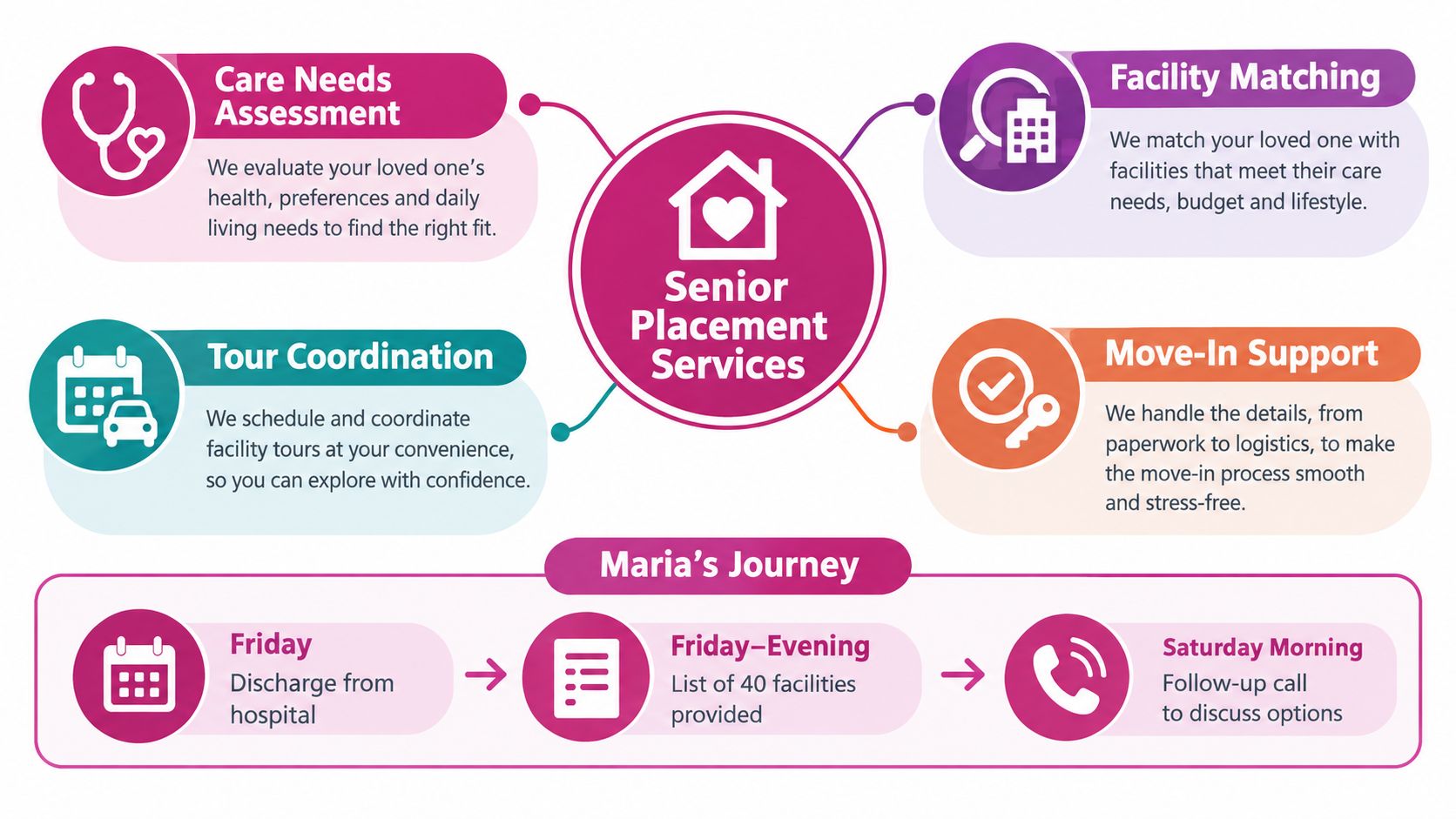
Maria's father is being discharged on Friday. By Saturday morning, she's called 12 facilities, left voicemails at most of them, and found out that three aren't even taking new residents. The hospital list looked helpful on paper, but it didn't tell her which communities had a bed, which ones could handle his needs, or which ones were months out on a waitlist.
That is where senior placement services earn their keep. They're not a search engine and they're not a sales desk for one building. They're a matching service, usually advisor-led, that looks at a senior's health needs, budget, geography, and timeline, then narrows the field to communities and care providers that can take the person.
Who uses them
Adult children use them when work, kids, and caregiving are colliding. Out-of-town family members use them because they can't tour every building themselves. Hospital discharge planners and social workers use them when a patient needs a next step fast. Seniors also use them proactively, before a crisis forces a rushed decision.
A placement advisor works across multiple communities, which matters. A facility's in-house marketing team can only sell that one building. An advisor can tell you which places fit assisted living, memory care, nursing homes, independent living, or home care, then point you toward the current openings instead of a brochure.
Practical rule: If the person helping you only talks about one community, you're not getting placement help, you're getting a sales pitch.
Families also need to understand the scale of the problem behind the service. The global senior living market is projected at USD 84.3 billion in 2025 and USD 185.6 billion by 2034, while the population aged 60+ is expected to rise from about 1.0 billion in 2020 to 1.4 billion by 2030 and 2.1 billion by 2050 (DataIntelo). That growth is exactly why placement work has become a specialized layer between families and providers.
For a family trying to sort through the basics of assisted living itself, this complete guide to assisted living is a useful companion to the matching process.
Levels of Care a Placement Service Can Match
Most families start with a vague request, then discover they're really asking for the wrong thing. “She needs assisted living” often turns out to mean “She needs memory care,” or “He wants to stay at home, but only if someone can help with bathing and meds.” A good advisor hears the need behind the first sentence.
The five settings in plain English
Independent living is the hotel-style option for active seniors who want meals, housekeeping, and social life without hands-on care. Think of it as convenience housing, not a care setting. It works when the person can manage daily life and mainly wants less home maintenance.
Assisted living is the apartment-with-help model. Residents usually have private units, meals, medication reminders, and staff available 24/7, but they still need to be mostly able to walk, eat, and manage a good part of daily life.
Memory care is assisted living with more structure, often including a secured environment for people with dementia-related wandering, confusion, or unsafe behavior. If the question is about safety and supervision as much as support, the conversation usually lands here. For families comparing tours, the questions for dementia care tours resource is worth using before you visit.
Nursing homes, or skilled nursing facilities, provide daily medical care from licensed nurses for people who can't be safely cared for elsewhere. After a stroke, a fracture, or a complex illness, this is often the right setting when rehab or round-the-clock oversight is needed.
Home care sends caregivers into the senior's own house for hourly or live-in help. It can cover personal care, companionship, and support with daily tasks, but it doesn't replace the structure of a licensed residential setting.
A quick way to sort the choice
- Mostly independent, wants convenience: Start with independent living.
- Needs reminders, meals, and routine help: Look at assisted living.
- Has dementia or wandering risk: Memory care should move up the list.
- Needs skilled nursing or rehab support: Nursing home placement is more realistic.
- Wants to stay home, but needs a caregiver: Home care may be enough for now.
| Care Setting | Best For | Staffing | Typical Cost |
|---|---|---|---|
| Independent Living | Active seniors wanting convenience | Limited care staff | Usually lower than assisted living |
| Assisted Living | Help with daily tasks and supervision | 24/7 support staff | Mid-range, varies by care needs |
| Memory Care | Dementia-related safety and routine | Higher supervision than assisted living | Usually higher than assisted living |
| Nursing Home | Complex medical or rehab needs | Licensed nurses and clinical staff | Usually the highest residential setting |
| Home Care | Support in the senior's own home | Caregivers by the hour or live-in | Depends on schedule and intensity |
If you're still sorting the basics of apartment-style support versus more hands-on care, this assisted living guide gives a cleaner picture of where assisted living fits.
How Senior Placement Services Get Paid
Families ask this right away, and they should. The service is usually free to the family because the community pays the placement agency after a move-in happens. In practice, that fee is often tied to a referral relationship, sometimes as one month's rent or a percentage of move-in revenue, which is why the advisor can spend time on intake calls, shortlists, and tour coordination without billing you directly.
What that means for you
The upside is obvious. You're not paying upfront for the search, and you can get help quickly when you're under pressure. That matters when a discharge date is fixed and you don't have time to spend evenings chasing every admissions desk in the county.
The trade-off is also real. Because the community funds the placement, the shortlist can lean toward communities that pay referral fees and have current availability. That doesn't make the service bad, but it does mean you should ask what didn't make the list and why.
Ask directly, “Which nearby communities aren't on your list, and what's the reason?”
Reputable advisors are upfront about how they're paid, don't charge hidden family fees, and won't place someone in a setting that can't clinically serve them. Medicare, Medicaid, and most long-term care insurance plans don't reimburse the placement service itself, although some policies may help pay for the care that follows.
DIY Search Versus Working With a Placement Advisor
A DIY search feels manageable until you're deep in it. Then you're stuck with Google results, a spreadsheet of 40 communities, and a phone tree that eats days while you wait to reach an actual admissions director. That works if you've got time, but time is exactly what many families don't have.
Where the advisor changes the equation
A placement advisor is still using the same market, but they're working with relationships and live availability, not just public-facing marketing. That matters in a tight market, because families searching alone often see polished websites, not the room that's open this week.
- Effort: DIY takes a lot of calls, note-taking, and follow-up. Advisor-led search usually cuts that down to a few intake conversations.
- Speed: DIY can stretch into weeks. An advisor can often move faster when a discharge or decline has created urgency.
- Fit: Families searching alone tend to compare amenities. An advisor compares care level, budget band, and location.
- Availability: The gap gets widest. A family can love a community that has no realistic opening.
Families with months of runway, strong clinical literacy, and time to tour can absolutely do this themselves. But if the situation is complex, or the move has to happen fast, the advisor usually earns the call. If you want to see how communities are found and filtered, this local guide to finding senior living homes is a good companion to the search process.
The Three-Step Placement Process From Intake to Move-In
The process should be organized, not fuzzy. If the advisor starts with a generic list instead of a structured intake, that's a warning sign. Real placement work starts with details, because the wrong details lead to the wrong move.
Step one, intake
The first call should run about 45 to 60 minutes and cover medical needs, mobility, cognition, behavioral triggers, geography, budget, and the move-in window. Bring the current medication list, the discharge summary if there is one, and a clear answer on who makes the final decision.
That call is where the advisor should identify the essential needs. If the person falls, wanders, refuses meds, or needs help with transfers, that changes the search immediately. A good intake prevents the common mistake of touring pretty buildings that can't handle the actual care need.
Step two, the matched shortlist
The advisor should return a short list, usually three to five communities, filtered by care level, price band, and current availability. Each option needs a reason for being there. One might be lower cost but farther away. Another might be newer but unavailable until spring.
If the advisor can't explain the trade-offs, the list is too vague to trust. This is also the point to compare a community's life plan services with practical needs at home, especially if you're still weighing home modifications. The DME Superstore aging in place guide can help families think through whether the home should be adapted or whether it's time to move.
Step three, tours and decision
Tours should be scheduled quickly, and the advisor should help you ask harder questions than “Do you have activities?” Ask about staff coverage, move-out triggers, fee escalators, and what happens when care needs increase. The advisor should also help interpret contracts and coordinate the assessment most communities require before they say yes.
Rule of thumb: If the community can't explain the next step when care needs rise, you're not looking at a stable long-term fit.
Move-in often follows within one to four weeks of selection, and it can happen faster if there's a vacancy right now. After the decision is made, a strong advisor stays involved long enough to make the transition cleaner, not just to hand off a phone number and disappear.
Availability, Waitlists, and the Affordability Reality
Most families still shop as if the only question is, “Which place looks nicest?” That's outdated. The question is whether the right community has a bed at the right time, in the right price band, and with the right level of care.
Why the bottleneck changes the search
The U.S. Senior housing market is tight. NIC MAP projects annual need for more than 100,000 new units per year while the industry has been delivering roughly 10,000, and that gap is expected to leave the country more than half a million units short by 2030 and over 1 million short by 2035 (NIC MAP). That's not a minor inconvenience. It changes the entire search strategy.
Waitlists are no longer an edge case. In many metros, the preferred community isn't open when the family is ready. That's why availability has to be part of intake, not a follow-up question after you've fallen in love with a brochure.
Why budgets derail searches
Families also underestimate cost far too often. In ASHA/ProMatura consumer survey data, only 7% of assisted-living prospects said they were “very likely” to move, while 39% were unsure, and cost and long-term affordability were the biggest concerns for roughly 45% to 50% of respondents (ASHA/ProMatura consumer survey PDF). That hesitation is not ignorance. It's budget anxiety meeting a hard market.
Budget verification belongs at intake, not after tours. Ask about the base rate, care-level fee tiers, what triggers a rate increase, what happens if private funds run down, and whether Medicaid or VA benefits could matter later. If you're trying to understand how communities handle waitlists in practice, this overview of how waiting lists work is a useful reality check.
How to Choose a Senior Placement Service Worth Trusting
Treat this like hiring a specialist, because that's what it is. You're not buying a tour. You're asking someone to help steer a family through a high-stakes decision with money, safety, and timing all on the line.
What to verify before you commit
Start with the basics. Ask whether the service has state-level licensure or regulatory status where that applies, who pays them, and how they're compensated. Ask for named local communities they can place into, not vague promises about “a network.”
Then ask for references from families placed in the last six to twelve months. If they hedge, that's useful information. A real advisor can talk clearly about recent placements, limited availability, and the communities they work with most often.
- Who pays you, and how is that disclosed?
- Which communities are you currently able to place into?
- Do you do in-person assessments, or only phone intake?
- How do you handle communities with no openings?
- Can you explain your contract terms and any exclusivity clause?
Red flags are easy to spot if you're paying attention. A call center that reads from scripts is not the same thing as an advisor. Neither is a service that pushes one building too hard, avoids discussing funding, or refuses to name the communities it works with.
Life Senior Placement is one example of a service in this category. It matches families with assisted living, memory care, nursing homes, independent living, and home care providers, and it offers no-cost guidance for the search and move-in process.
What to do next
Talk to two or three advisors in parallel and compare the shortlists they give you. If they all point to the same few communities for the same reasons, you're probably in the right zone. If one person pushes harder than the others, ask why.
The best placement help doesn't pretend choice is easy. It makes the choice sharper, faster, and more honest.
If you need help sorting care level, current openings, and what will work for your family in New Jersey, contact Life Senior Placement and start with a real intake conversation. Their team can help narrow the field, compare options, and move you from uncertainty to a workable plan without charging your family for the search.